Debt advice
DMP, DRO, IVA or Bankruptcy? UK Debt Solutions Compared
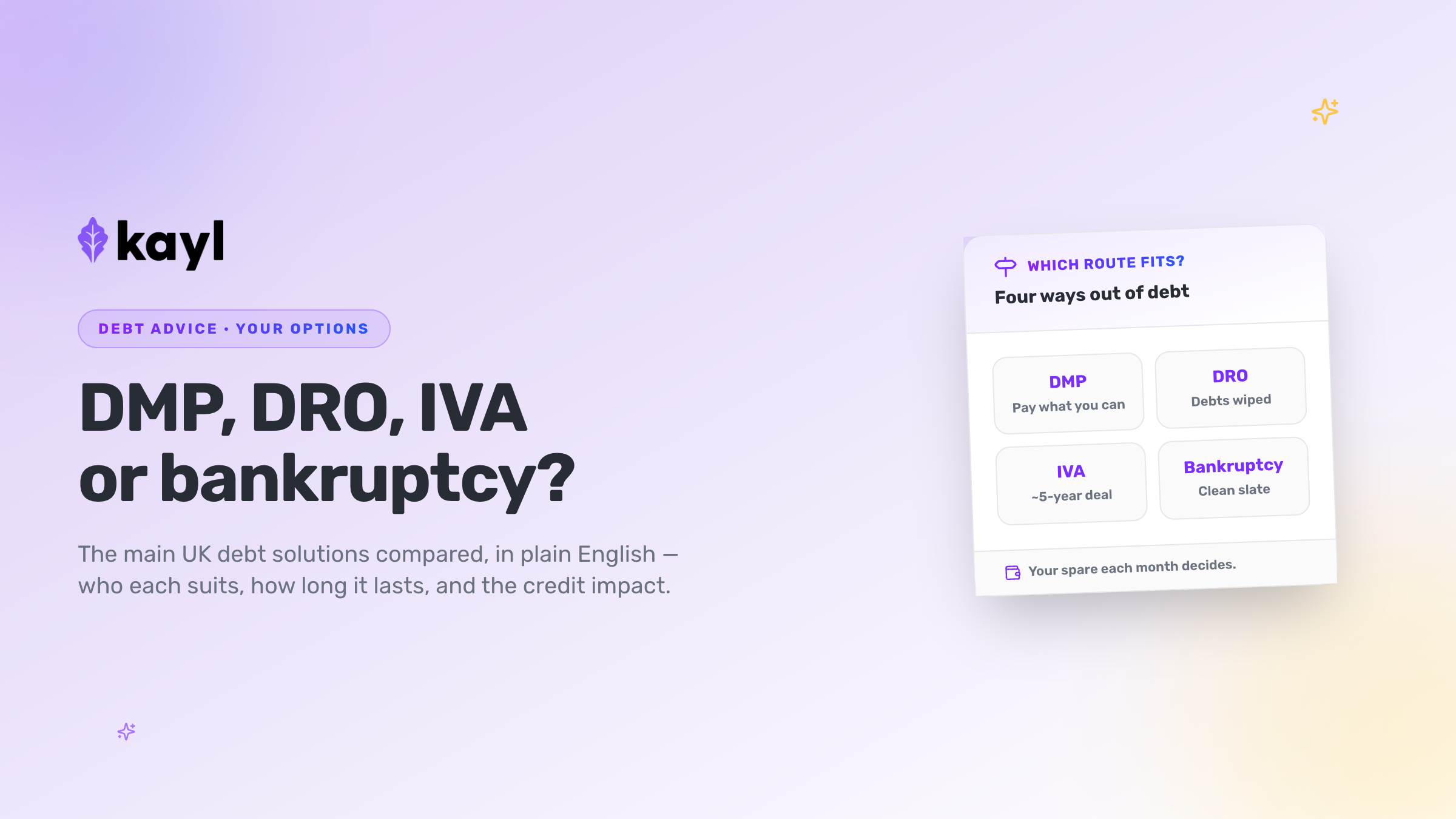
If you're staring at a list of letters — DMP, DRO, IVA, bankruptcy — and feeling your chest tighten, take a breath. These are just different routes out of debt. None of them is a punishment, and none of them means you've failed.
This post walks through the main debt solutions in England and Wales in plain English. For each one: who it may suit, roughly how long it lasts, and what it does to your credit file. Every figure here is checked against official sources, and we link them so you can see for yourself.
One thing first, because it matters most: you should never pick one of these on your own. A free, regulated debt adviser looks at your real numbers and tells you which ones you actually qualify for. This post is here so the conversation makes sense — not to replace it.
The short version
There is no single "best" debt solution — the right one depends on how much you owe, what you own, and what you can spare each month. Roughly: a Debt Management Plan (DMP) suits you if you can pay something but not the full amount; a Debt Relief Order (DRO) is for low income, low debt and few assets; an Individual Voluntary Arrangement (IVA) suits larger debts you could never fully clear; and bankruptcy is for when there's no realistic way to repay. Breathing Space isn't a solution at all — it's a short pause while you decide. A regulated adviser uses your income-and-expenditure budget to match you to the right one, free of charge.
If you haven't built that budget yet, our guide on what a debt adviser can do with your Standard Financial Statement explains why it's the starting point for all of this.
First, a word about the SFS
Every option below depends on one document: your Standard Financial Statement (SFS). It's the standard income-and-expenditure budget that creditors and debt advisers use. It shows what comes in, what goes out, and what you have spare each month.
That spare figure is the key that unlocks everything. Too little spare, and more of your debt may be written off. Enough spare, and you'll likely pay some back over time. An adviser reads that number and works out which solution fits.
Informal arrangements and the Debt Management Plan (DMP)
The gentlest route is an informal arrangement. You — or an adviser — ask your creditors to accept smaller payments for a while. A Debt Management Plan is a tidy version of this: you make one affordable payment each month to a provider, and they share it out between your debts.
Free DMPs are offered by StepChange, National Debtline and others. StepChange is clear that its DMP is free and flexible — you can start, pause and restart it as your life changes. There's no fixed limit on how much you can owe.
The catch is that a DMP is informal. It isn't legally binding, so creditors can refuse the reduced payments or keep adding interest, though many agree to freeze it. You still repay the full amount eventually, so the plan lasts as long as it takes — often several years.
Who it may suit: you can pay something each month, just not the full amounts, and you expect things to stay stable or improve.
Credit impact: StepChange notes the DMP itself isn't recorded on your credit file, but paying less than you originally agreed lowers your credit rating. Any defaults or County Court Judgments stay on your file for six years from the date you got them.
Debt Relief Order (DRO)
A Debt Relief Order is for people on a low income with very little spare and few assets. You pay nothing for 12 months, and if your situation hasn't improved, the included debts are wiped for good.
According to GOV.UK, you may qualify if all of these are true:
- you owe less than £50,000
- you have less than £75 spare each month
- your assets are worth less than £2,000
- you don't own a vehicle worth £4,000 or more
There used to be a £90 application fee. That fee was abolished in England and Wales from 6 April 2024, so a DRO is now free. You can't apply on your own — you must go through an approved debt adviser, who checks you qualify at no cost.
Who it may suit: low income, smaller debts, and almost nothing spare or owned.
Duration: lasts 12 months, after which the included debts are cleared.
Credit impact: it stays on your credit file for six years.
Individual Voluntary Arrangement (IVA)
An Individual Voluntary Arrangement is a formal, legally binding deal between you and your creditors, set up by a licensed insolvency practitioner. You pay what you can afford each month, and at the end, whatever's left is written off.
The Insolvency Service says an IVA usually lasts 5 years. It can run to six years if you own a home with significant equity, because some of that value may be counted in to compensate creditors, as set out in the official IVA protocol.
Because an IVA is formal, it's binding on your creditors once agreed — they can't keep chasing you or add interest. But it also appears on the public Individual Insolvency Register while it's running, and insolvency practitioners usually charge fees, which come out of your payments.
Who it may suit: larger debts you could pay a bit towards each month but could never clear in full, especially if you have assets you want to protect through a structured deal.
Duration: typically 5 years (6 with significant home equity).
Credit impact: it stays on your credit file for six years from the date it starts.
Bankruptcy
Bankruptcy is often the most feared word on the list, but for some people it's the kindest route — a clean line under debts there's no realistic way to repay. Most of your debts are written off.
It costs £680 to apply in England and Wales. As MoneyHelper explains, that's made up of a £130 application fee and a £550 deposit, paid up front (you can pay in instalments, but the full amount must be paid before your application is sent). MoneyHelper strongly suggests talking to a free debt adviser before you pay, because for many people another option is better.
You're usually discharged — freed from the debts and most restrictions — after about 12 months. An adviser only suggests bankruptcy when nothing else fits, and they'll explain exactly what you get to keep.
Who it may suit: there's honestly no realistic way to repay what you owe, and other options don't work.
Credit impact: it stays on your credit file for six years, and your details appear on the Insolvency Register during the bankruptcy and for three months after.
Breathing Space — a pause, not a solution
Breathing Space (the Debt Respite Scheme) isn't a way to clear debt. It's a legal pause that gives you room to get advice and choose a route.
Per GOV.UK guidance, a standard Breathing Space protects you for up to 60 days. During that time, most interest and charges are frozen and creditors must hold off chasing you. There's also a mental health crisis version, which lasts for as long as your crisis treatment continues, plus 30 days after it ends.
You can only start a Breathing Space through an FCA-regulated debt adviser. It's the pause button while you pick one of the options above.
The options side by side
| Option | Who it may suit | Rough duration | On credit file |
|---|---|---|---|
| DMP | Can pay something monthly, not the full amount | As long as it takes to repay | Not recorded directly; reduced payments lower your rating; defaults/CCJs 6 years |
| DRO | Low income, under £50k debt, under £2k assets, under £75 spare | 12 months, then debts wiped | 6 years |
| IVA | Larger debt, can pay a bit, could never clear it all | Usually 5 years (6 with home equity) | 6 years from start |
| Bankruptcy | No realistic way to repay | Usually discharged after ~12 months | 6 years |
| Breathing Space | Need time to get advice (not a solution) | Up to 60 days (longer for mental health crisis) | Not a solution; a pause |
Every one of these should be chosen with a free, regulated debt adviser. They'll use your SFS to see which you qualify for and which fits best. Please don't try to pick from a table alone — this is what advisers do all day, for free, without judgement.
Frequently asked questions
Which debt solution is best? There's no single best one. The right route depends on how much you owe, what you own, and what you can realistically spare each month. A low income with little spare points towards a DRO; a larger debt you can chip away at points towards a DMP or IVA; no realistic way to repay points towards bankruptcy. A free regulated adviser matches your numbers to the right option.
Will this ruin my credit score? Most formal solutions stay on your credit file for six years, and a DMP lowers your rating while you pay less than you agreed. That sounds heavy, but a credit file recovers — and carrying unpayable debt is already affecting it. The point of these routes is to get you to a place where you can rebuild. An adviser will talk you through the trade-off honestly.
Do I have to pay for debt advice? No. Debt advice from StepChange, National Debtline and Citizens Advice is completely free. A DRO is free to apply for, and a DMP from a free provider costs nothing. IVAs and bankruptcy do have costs, which a free adviser will explain before you commit to anything. You should never pay a company just to be told what your options are.
Can I change my mind or switch solutions? Informal routes like a DMP are flexible — you can pause, restart or move to a different option if your circumstances change. Formal routes like an IVA or bankruptcy are harder to unwind once they start, which is exactly why getting advice first matters so much.
What if I just need time to think? That's what Breathing Space is for. A regulated adviser can give you up to 60 days with interest frozen and creditors held back, so you can decide without pressure.
What to do next
- Get free, regulated advice. Contact StepChange, National Debtline on 0808 808 4000, or Citizens Advice. All free. All on your side. They'll tell you which solution fits — and set it up.
- Walk in with your numbers ready. Build your SFS with KAYL. It connects to your bank through FCA-authorised Open Banking (read-only, no login details stored) and turns your real data into a Standard Financial Statement in about 10 to 20 minutes. KAYL builds the document; your adviser recommends the route. Essential features are free forever.
- Prepare for the call. Our StepChange prep guide walks you through what to have ready so your appointment goes as smoothly as possible.
None of these options is failure. They're the way out — and you don't have to work out which one alone.