Debt advice
What a debt adviser can do with your Standard Financial Statement
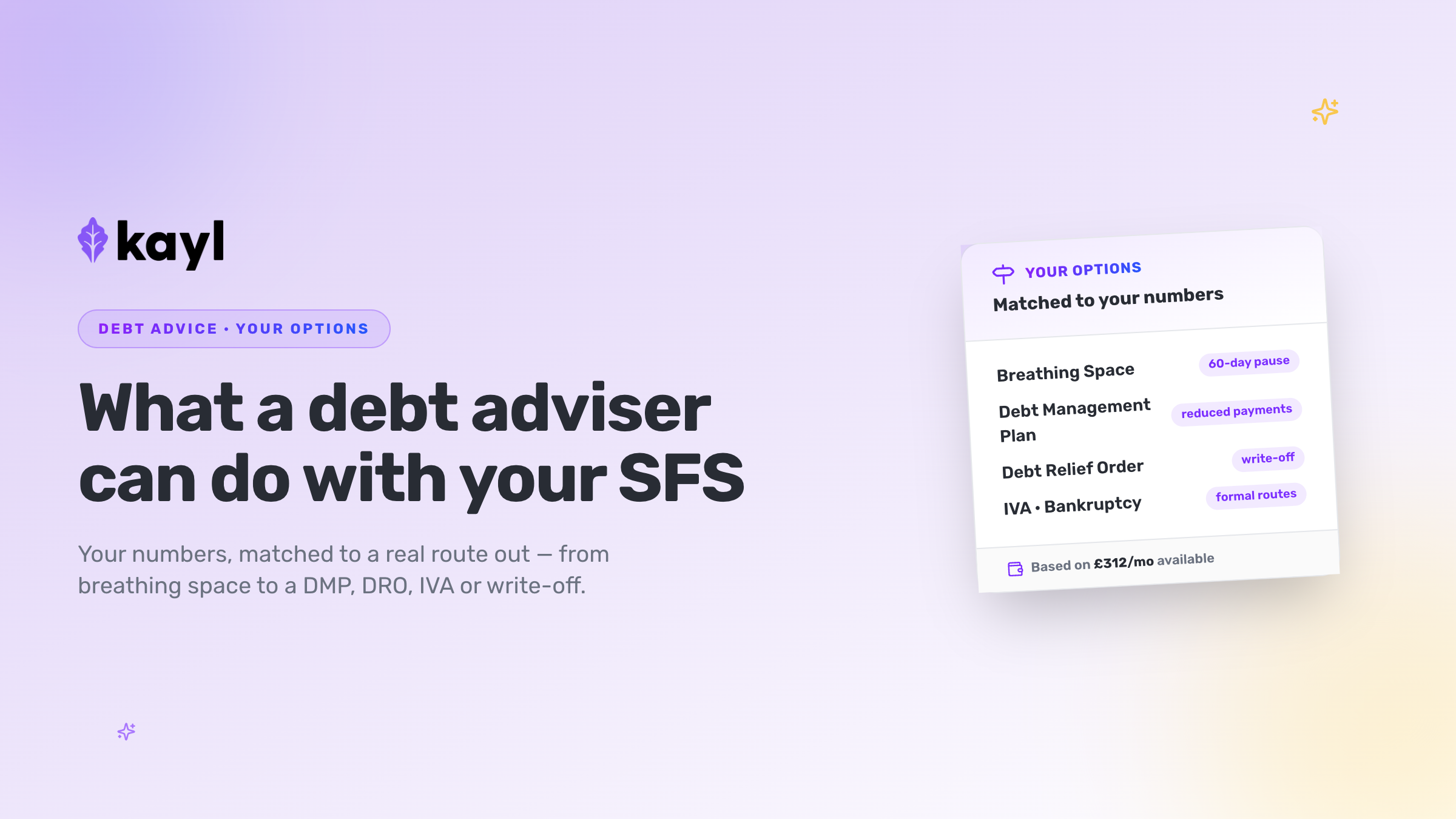
You've done your Standard Financial Statement (SFS). It shows what comes in, what goes out, and what's left for your debts.
So what happens when you show it to a debt adviser? They look at one number — what you have spare each month — and use it to find you a way out. Here are the ways out, in plain English.
New to the SFS? Start with our simple guide.
The adviser is on your side
They are not there to judge you. They talk to people in your situation every day.
Their job is to answer three questions:
- Which debts are urgent?
- What can you actually afford?
- Which option fits?
The rest of this page is the options.
Urgent debts come first
Some debts are more dangerous than others. An adviser sorts yours into two piles.
- Urgent debts: rent, mortgage, council tax, gas, electric, court fines, tax. Miss these and you could lose your home or go to court. These get sorted first.
- Everything else: credit cards, overdrafts, loans, catalogues, Klarna. Big and scary, but less dangerous.
Your SFS already shows which is which.
Need time? Press pause
An adviser can start a Breathing Space for you.
For 60 days it freezes interest and stops creditors chasing you. It gives you room to breathe while you pick an option. Only an adviser can set it up.
Your options
The less you have spare, the more likely your debt gets written off. The more you have spare, the more likely you pay some of it back. Here's the menu.
1. Small payments
You ask your creditors to accept less for now — even £1 a month. Your SFS proves it's all you can spare, so they usually say yes and stop chasing you. You still owe the money. You just pay more later, when you can.
Best if: money is very tight right now, maybe just for a while.
2. Debt Management Plan (DMP)
You pay one amount each month to a company like StepChange. They share it out between your debts, so you're not dealing with everyone yourself. They usually get the interest stopped, so the debt stops growing. It's free, and there's no limit on how much you owe.
Best if: you can pay something each month, just not the full amounts.
3. Debt Relief Order (DRO)
Your debts get cancelled. You pay nothing for a year — and if things haven't got better, the debts are wiped for good. It's free to apply.
Best if: you're on a low income with almost nothing spare. Rough limits: you owe under £50,000, have under £2,000 saved, and £75 or less left each month.
4. Individual Voluntary Arrangement (IVA)
You pay what you can afford for about five years. Whatever's left at the end is cancelled. It's a legal deal, so it goes on your credit file, and if you own a home some of its value may be counted in.
Best if: you owe a larger amount and can pay a bit each month, but could never clear it all.
5. Bankruptcy
Most of your debts are cancelled. It costs £680 and usually lasts a year. An adviser only suggests it when nothing else works — and they'll explain exactly what you get to keep.
Best if: there's honestly no realistic way to pay back what you owe.
In Scotland the names are different (DAS, Trust Deeds, sequestration), but it works the same way: your spare money decides which option fits.
What an adviser does that you can't
Your SFS gets you most of the way. The adviser does the rest:
- Checks you qualify. The rules change. They know the current ones.
- Sets up the legal protections, like Breathing Space.
- Talks to your creditors for you, and freezes the interest.
- Handles the forms.
- Stops you making it worse — like paying a credit card while ignoring council tax.
Why the SFS has to be right
Every option depends on one number: what you truly have spare each month.
Guess too high and you'll agree to a plan you can't keep. Guess too low and a creditor says no.
That's why we built KAYL. It reads your real bank data (safely, read-only) and builds your SFS in 10 to 20 minutes. You turn up with the numbers done — and the adviser goes straight to helping.
What to do next
- Want free advice? Call StepChange or National Debtline on 0808 808 4000. Both free. Both use the SFS.
- Want your numbers ready first? Build your SFS with KAYL, then take it to them. Our prep guide covers the rest.
None of these options are failure. They're the way out. Your SFS is how you get there faster.