Money & support
The Warm Home Discount 2026/27: £150 Off Your Energy Bill (UK Guide)
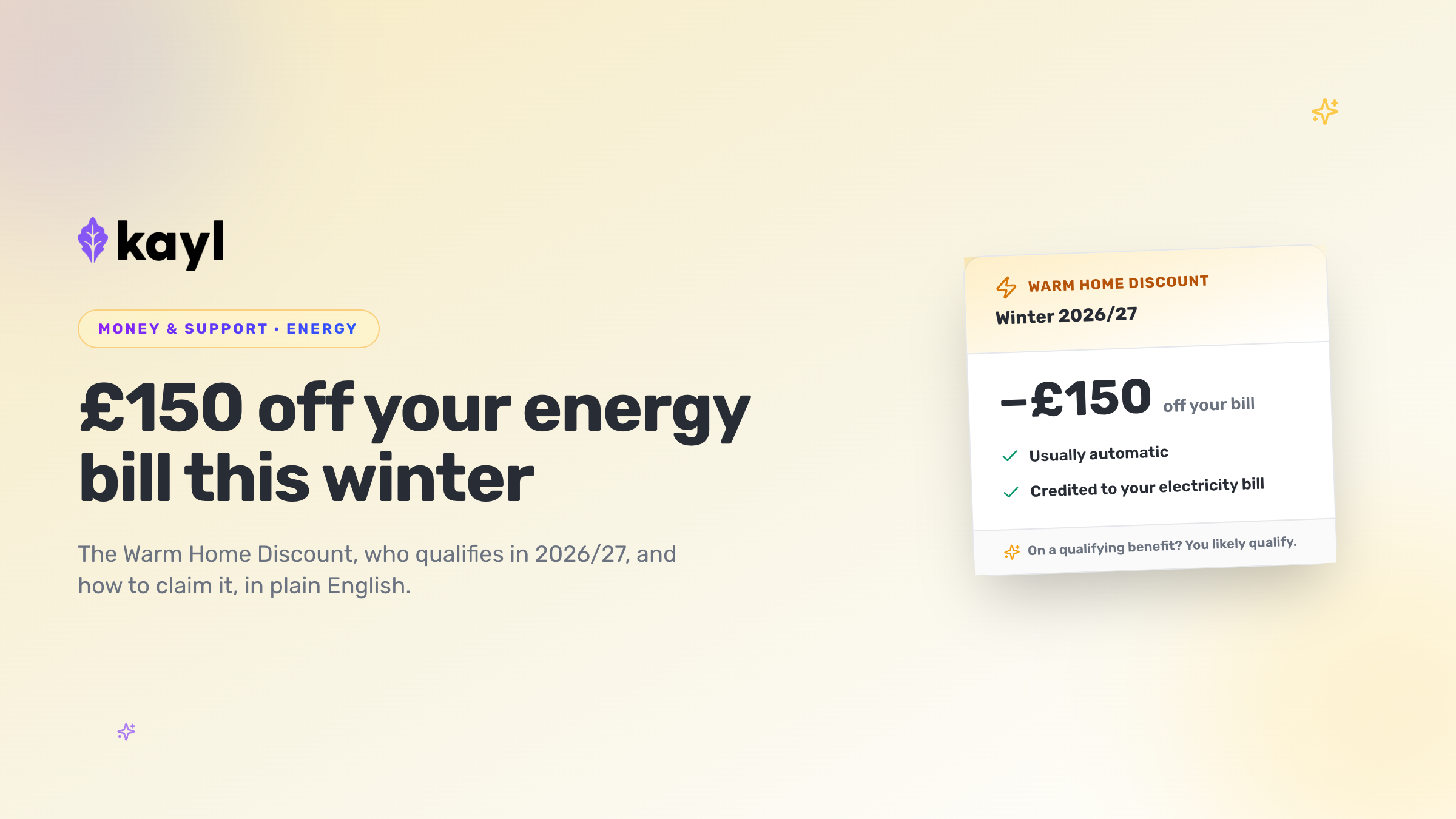
Energy bills are high again this winter, and heating your home shouldn't feel like a luxury. The Warm Home Discount is a government scheme that takes £150 off your electricity bill if you're on a low income or certain benefits. Most people who qualify get it automatically — you don't have to do anything — but it's worth knowing the rules so you don't miss out.
This guide walks through what it is, who can get it for winter 2026/27, and how the money actually reaches you.
The short version
The Warm Home Discount is a one-off £150 credit on your electricity bill. You usually get it if you or your partner receive a qualifying means-tested benefit and your name is on the bill. For most people in England and Wales it's automatic — a letter arrives and the discount lands on your bill over the winter. In Scotland it works a little differently, and some people have to apply. You can check the full, up-to-date rules on the gov.uk Warm Home Discount page.
If money feels tight right now, you're in good company — and there's more help around than most people realise.
Energy costs are still high this winter
Here's the backdrop. From 1 October to 31 December 2026, Ofgem's energy price cap sets the typical annual bill for a household paying by direct debit at around £1,723 a year — up from £1,663, a rise of about 4%. The cap limits the price you pay per unit of gas and electricity, not your total bill, so if you use more, you pay more.
The important thing to understand is that the cap is still well above where bills sat a few years ago. Winter is when you use the most energy, so this is exactly the time of year when the squeeze bites hardest. That's the whole reason schemes like the Warm Home Discount exist: to put money back towards the bills that climb when it's cold.
If the bigger picture feels overwhelming — bills, debts, the lot — our guide on what to do when you can't afford your repayments is a calm place to start.
What the Warm Home Discount actually is
The Warm Home Discount is a £150 discount on your electricity bill, funded by the government and paid through energy suppliers. A few things are worth being clear about:
- It's not cash. The £150 doesn't land in your bank account. Your electricity supplier takes it off your bill as a credit.
- It's usually automatic. If you qualify, most of the time you don't apply — the discount just appears.
- It comes once a year, over the winter months, roughly between autumn and the end of March.
- Prepayment meters count too. If you top up as you go, you can still get it, often as a voucher or a credit added to your meter. gov.uk explains how your supplier will pay it.
One more reassuring point: getting the Warm Home Discount does not affect your other benefits, and it doesn't touch separate help like the Cold Weather Payment or Winter Fuel Payment.
Who qualifies in 2026/27 (England and Wales)
This is the part that changed for the better. The scheme used to have a "high energy costs" test — working-age households had to be on a benefit and live in a home that was expensive to heat. That extra hurdle was removed in 2025, which means the rules are now much simpler: broadly, if you're on a qualifying means-tested benefit and your name is on the electricity bill, you qualify. That change brought the number of eligible households in Great Britain to around six million.
For winter 2026/27 in England and Wales, you're likely to qualify if, on the qualifying date of 23 August 2026, all of these were true:
- Your electricity supplier was part of the scheme (most big suppliers are).
- You or your partner received one of the qualifying benefits (below).
- Your name, or your partner's, was on the electricity bill.
The qualifying means-tested benefits listed in the official gov.uk eligibility statement for 2026/27 are:
- Pension Credit (the Guarantee Credit and Savings Credit parts)
- Universal Credit
- Income-related Employment and Support Allowance (ESA)
- Housing Benefit
A quick honesty note: the list of qualifying benefits can shift from year to year, and some benefits that qualified in the past (such as Income Support and income-based Jobseeker's Allowance) aren't on the current England and Wales list. So if you're not sure whether your benefit counts, don't guess — check the gov.uk page for the latest, or ring the helpline shown there.
How you get it, and how to claim
For most people in England and Wales, there's nothing to claim. Here's how it usually plays out:
- A letter arrives between late October 2026 and early January 2027.
- If the letter says you're eligible, you don't need to do anything. Your supplier applies the £150 to your bill.
- If the letter says you might be eligible, it will ask you to phone the Warm Home Discount helpline to confirm a few details — usually by 26 February 2027. This mostly affects people on Universal Credit, where the government may need to check your income.
- The discount is applied by 31 March 2027 at the latest, though many people get it before the new year.
What if no letter comes? If you think you qualify but haven't heard anything by early January 2027, contact the Warm Home Discount helpline (the number is on the gov.uk page) to check. It's also worth a quick call to your energy supplier — they can tell you whether they're part of the scheme and whether you're on their list.
One warning: scammers love this time of year. The government and your real supplier will never text or email asking for bank details to "release" your Warm Home Discount. If a message asks you to hand over details or click a link to claim, treat it as a scam.
How it's different in Scotland
Scotland runs the scheme in two groups, and the second one matters a lot.
- The Core Group works like England and Wales: if you qualify (for example, you receive Pension Credit), the government writes to you and the discount is applied automatically. You don't apply.
- The Broader Group is for other low-income households, and here's the key difference — you usually have to apply directly to your energy supplier. Funding is limited and places are given out first come, first served, so once your supplier's pot runs out, applications close for the year.
If you're in Scotland and not on Pension Credit, the message is simple: don't wait for a letter. Check your supplier's website as soon as their application opens (usually in the autumn) and apply early. The gov.uk Scotland guidance explains who's in which group.
(There's no equivalent scheme in Northern Ireland, which has its own separate energy support.)
Other help worth knowing about
The Warm Home Discount isn't the only support out there, and it's fine to use more than one. A few to look into:
- The Priority Services Register — a free service from your energy supplier and network. It can get you extra support if you're of pension age, disabled, or have a health condition, such as advance warning of power cuts.
- Cold Weather Payment and Winter Fuel Payment — separate payments for people on certain benefits or of a certain age, which don't clash with the Warm Home Discount.
- Free, impartial help — a charity like Citizens Advice or National Energy Action can check what you're entitled to and talk to your supplier with you if your bills are unaffordable.
How KAYL helps you see what you qualify for
Here's the quiet problem with schemes like this: a lot of people miss out simply because they don't realise they're on a qualifying benefit, or they're not sure what their income actually is. The money is there — they just can't see their own picture clearly.
That's where KAYL can help. KAYL is a UK app that connects to your bank through FCA-authorised Open Banking (read-only, and it never stores your login details). Because it reads your real income and the benefit payments landing in your account, it lays them out clearly in one place — so you can see at a glance which benefits you're on and what your income is. That's exactly the information you need to check whether you qualify for support like the Warm Home Discount, and to claim the other help you're entitled to.
To be clear about what KAYL is and isn't: it doesn't run an automatic "Warm Home Discount checker", and it isn't a debt-advice service. What it does is turn your real bank data into a clear Standard Financial Statement (SFS) — the UK-wide budget format — in about 10 to 20 minutes, so your income, benefits and outgoings are all visible in one place. If you'd like to understand that document first, our plain-English guide to the SFS explains it gently. KAYL's essential features are free forever, and it's currently in private beta.
Frequently asked questions
Do I need to apply? In England and Wales, usually not — most people get it automatically after a letter arrives. The exception is if your letter asks you to call and confirm your details. In Scotland, the Core Group is automatic, but the Broader Group means applying to your supplier, so check their site early.
When will I get it? The discount is applied to your electricity bill over the winter, by 31 March 2027 at the latest. Many people receive it before the new year.
I'm on Universal Credit — do I qualify? Universal Credit is one of the qualifying benefits, so you may well qualify. For some Universal Credit claimants the government checks income, which is why your letter might ask you to confirm a few details. Follow what the letter says, and check the gov.uk page if you're unsure.
What if I use a prepayment meter? You can still get it. Your supplier will explain how — often as a voucher to top up your meter, or a credit added automatically. If you're not sure, ask your supplier directly.
Does it affect my other benefits? No. The Warm Home Discount doesn't reduce your other benefits, and it's separate from the Cold Weather Payment and Winter Fuel Payment.
What to do next
- Check the official rules. The gov.uk Warm Home Discount page has the current benefit list, dates and helpline number — always the safest place to confirm your situation.
- Talk to your energy supplier. Ask whether they're part of the scheme and whether you're on their list — especially in Scotland, where the Broader Group means applying early before funds run out.
- Get free advice if bills are unaffordable. Citizens Advice, MoneyHelper and National Energy Action are all free and used to helping people in exactly your position.
- See your own picture clearly. Try KAYL to lay out your income and the benefits landing in your account in one place — so you can see what you're on, check what you qualify for, and claim what you're owed.
A cold home is never a sign you've done something wrong. This support exists because winter is hard and bills are high — so take what's yours, and don't be shy about asking for help along the way.